

Edwin
Edwin
Información
- Suspendido
- Nombre de usuario
- Edwin
- Miembro desde
- Visitas
- 6,743
- Última vez activo
- Roles
- Forista
- Puntos
- 17,792
- Insignias
- 13
Insignias destacadas


-
Corporación de la Industria Aeronáutica Colombiana "CIAC"
CIAC CIAC_ 22 sept.
En CIAC le realizamos trabajos de modernización a los UH-60. Conozca más acá #GSED http://bit.ly/Modernizacion

-
Sistemas de artillería de campo del Ejército de Colombia
Primera División Ejercito_Div1 Hace 28 minutos
El Sr MG Suárez cdte del CCON1 el BG Navarrete cdte @Ejercito_Div1 y su Estado Mayor llegan a la Fuerza de Tarea de Armas Combinadas

-
Noticias de la ARC
-
Cotecmar

-
Corporación de la Industria Aeronáutica Colombiana "CIAC"
Cortesía: www.ciac.gov.coHacemos entrega del A-29 FAC 3106

Hacemos entrega del A-29 FAC 3106
Durante 34 días, seis colaborades de la CIAC, entre pintores ingenieros y diseñadores, trabajaron en la pintura del avión Supertucano de la Fuerza Aérea Colombina con matrícula FAC 3106.
Este es el tercer trabajo de este tipo que realizamos este año en la CIAC y nos sentimos muy orgullosos de los resultados, de igual forma agradeceos y resaltamos el apoyo y la logística de la Fuerza Aérea Colombiana para este trabajo de pintura.
Hoy recibimos en el hangar de mantenimiento de la CIAC el cuarto A-29 que se someterá inspección remoción de pintura, aplicación de base de pintura, aplicación de pintura, instalación de diseños y avisos y finalmente una prueba de peso y balance.


-
Cotecmar
Primera misión del "Gracias a Dios".
-
Noticias de la ARC
Foto ARC. Si ya fué publicada, créditos a quién lo hizo.

-
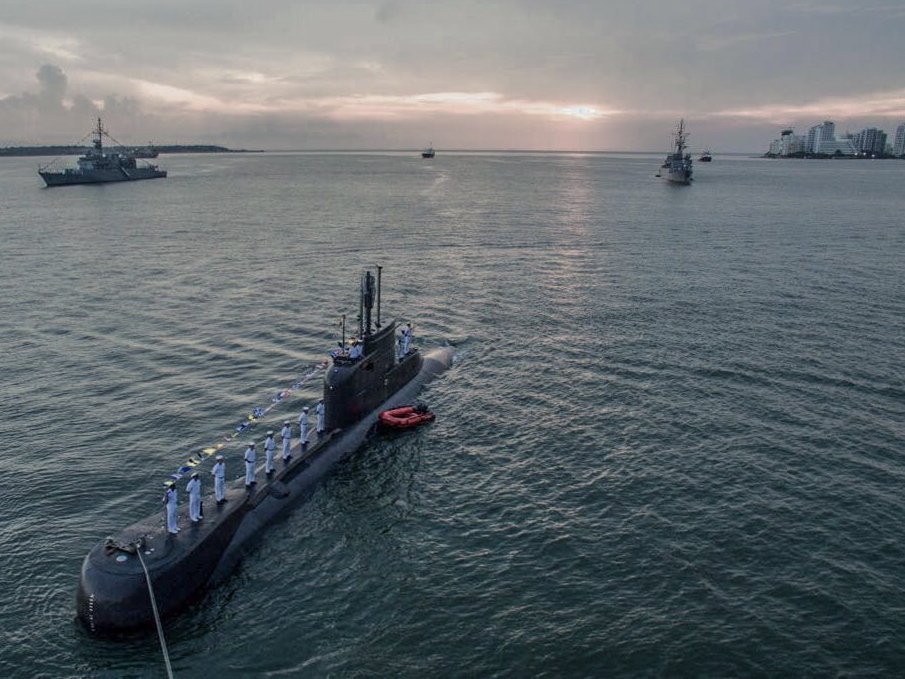
Submarinos Klasse U-206A de la ARC
-
Cotecmar
COTECMAR@COTECMAR Culminaron con éxito las pruebas de mar del Buque de Apoyo Logístico y de Cabotaje FNH "Gracias a Dios" de la @fuerzanavalhn


-
Cotecmar
Colombia Consolidates its Leadership Position in Naval Innovation
The Colombian Navy has built 115 models of marine vessels which they are now exporting to other countries in the region.Yolima Dussán/Diálogo | 23 June 2017Capacity Building

Exclusive economic zone patrol vessels have outstanding performance in sea conditions, which makes them efficient for long-term missions. (Photo: COTECMAR)
In Cartagena, Colombia, a port city along the Atlantic coast, the Colombian Ministry of Defense is setting sail on their industrial and technological course, launching one of their most significant programs at two large plants. At the Science and Technology Corporation for Naval, Maritime Industry Development (COTECMAR, per its Spanish acronym), the Colombian Navy has one of its most important regional manufacturers of ships, frigates, submarines, and patrol vessels, as well as the region’s largest exporter for vessel repair and maintenance. As a result of this process, 4,000 direct jobs and more than 11,000 indirect jobs were created in the country in 2016.
 The ARC offshore patrol vessel brings together an interdiction triad – a command and control platform, a helicopter, and a high-speed interceptor boat. (Photo: COTECMAR)
Circumstances in Colombia led the country to undertake processes to develop capacities that would allow it to meet the needs of its Navy, not only more quickly, but also at a lower cost. With criminal groups using its 25,000 kilometers of rivers, and 2,900 kilometers of coast to smuggle narcotics and contraband via the Atlantic and the Pacific, it was critical for Colombia to develop a project to expand its naval fleet, as well as to do effective maintenance for its existing fleet, and develop new and effective solutions for its vessels.
In search of leadership
“Between the year 2000 and now, we have built 115 [models] for the Colombian Navy. Honduras and Brazil have already acquired ships of ours. This is a story that began with a focus on the repair and maintenance of Colombian ships, and expanded into a large business project in which we used our knowledge, along with the government, through the Ministry of Defense, to dedicate ourselves to creating innovation through applied knowledge, everything from design to construction and repair of all types of vessels,” Vice Admiral Jorge Enrique Carreño Moreno, the president of COTECMAR, told Diálogo.
The country has the largest naval design office in the Americas to focus on the full construction cycle of ships and other naval vessels. Seventy designers are working on developing solutions for military and civilian use, based on new shipbuilding methods that require less time, with ever more qualified personnel.
Construction times vary depending on the vessel. Currently, that can be anywhere from eight to 24 months, starting from the delivery of the design. The high-complexity shipbuilding process is modular, which is a significant advancement in terms of efficiency of time and space.
Repair and maintenance for export
 Colombia has combined the export of services in repair, maintenance, upgrading, naval machining activities, etc., with the capacity to service up to 3,600 metric tons for lightweight ships docked and afloat. (Photo: COTECMAR)
 A focal point of the naval-evolution strategy is learning the needs of the region in order to respond in a timely manner. As such, four river patrol boats built at plants in Cartagena have been navigating Brazilian rivers since 2014. With a maximum speed of 27 knots, these fiberglass gliding vessels have rapid-response capability and easy access to places with space and depth restrictions.
In the case of Honduras, a logistical support and cabotage vessel is in construction. It is scheduled for delivery at the end of 2017 at a cost of $14 million.
“This vessel has the capacity to do ‘beaching’ maneuvers for loading and unloading operations of up to 300 metric tons of supplies that can fit in up to 10 containers in interior compartments. The vessel is highly maneuverable and can reach speeds of up to nine knots. It can remain autonomous for 40 days, travel 2,500 nautical miles, and operate with a crew of up to 15 men,” explained Commander Carlos Delgado, the head of Naval Construction at COTECMAR. “We have managed to rouse the interest of navies in the region to understand what we do in terms of other types of vessels, like heavy riverine support patrol boats,” added Vice Adm. Carreño.
The entire process allows the country to design and construct a significant and varied amount of naval, maritime, and riverine solutions. “That includes military and coast guard vessels, such as first-generation, exclusive-economic-zone patrol boats, amphibious landing craft, and coastal patrol boats,” Commander Carlos Alberto Mojica Valero, the vice president of Technology and Operations for the Colombian shipyard, told Diálogo.
Incremental evolution
“The lessons learned are the engine of our industry. Each of the vessels built at our shipyard has to surpass its predecessors. That is how it is. For instance, the river patrol boats and the light and heavy riverine support patrol boats are an example of continuous improvement in design and construction, with which we are evolving. [They are] a model of ‘incremental innovation,’ which has allowed us to create and build vessels that are better and better, both in their performance and in the building process,” Vice Adm. Carreño Moreno said.
An example of this incremental innovation is the river patrol boats which have a special armor included in the new constructions, due to the continuous attacks against them while they navigate rivers. On the other hand, the riverine support patrol boat line was developed by research groups from partner universities, using ballistic steel soldering processes so they can face the threats they are exposed to during patrols. They show the Colombian Navy’s dynamic use of naval, maritime, and riverine research, knowledge, design, and innovation.